USD/CADUSDCAD
Daily Market Briefing
Latest briefing
USD/CAD dips to 1.4210 as US Treasury yields decline, weakening the US Dollar.
In the past 24 hours, the USD/CAD pair has declined to 1.4210, influenced by a drop in US Treasury yields that has weakened the US Dollar. This movement has allowed the Canadian Dollar to strengthen, reaching a two-week high against its US counterpart. Investors are shifting capital from equities to government bonds amid concerns over debt-funded investments in the artificial intelligence sector.
Previous briefings
USD/CAD retreats to 1.4200 as US inflation data fuels US Dollar strength
Over the past 24 hours, the USD/CAD pair has experienced fluctuations, initially rising to 1.4287 on October 14, 2026, driven by robust US inflation data that bolstered the US Dollar. However, the pair has since retreated to the 1.4200 level, influenced by a pullback in the US Dollar and rising oil prices, which support the Canadian Dollar. Traders are now focusing on upcoming US inflation data and Federal Reserve communications for further direction.
USD/CAD retreats to 1.4250 as weak US consumer sentiment offsets Canadian dollar pressures
Over the past 24 hours, the USD/CAD pair has experienced a pullback to 1.4250, down from Friday's peak near 1.4300. This decline is attributed to weaker US consumer sentiment data, which has dampened the US dollar's strength. Additionally, the Canadian dollar faces downward pressure from declining crude oil prices and ongoing trade tensions with the United States.
USD/CAD reaches 18-month high near 1.4270 as oil prices decline
Over the past 24 hours, the USD/CAD pair has surged to an 18-month high near 1.4270, driven by a weakening Canadian Dollar amid falling global oil prices. As a major oil exporter, Canada's currency is sensitive to oil price fluctuations, and the recent decline has exerted downward pressure on the CAD.
USD/CAD reaches 18-month high near 1.4270 as oil prices decline
Over the past 24 hours, the USD/CAD pair has climbed to an 18-month high near 1.4270, driven by a weakening Canadian Dollar amid declining global oil prices. As a major oil exporter, Canada's currency is sensitive to oil price fluctuations, and the recent downturn has exerted downward pressure on the CAD.
USD/CAD trades near 1.4265 as hawkish Fed outlook strengthens US dollar.
The USD/CAD pair is trading near 1.4265, approaching its highest level since April 2025. This strength is driven by the Federal Reserve's hawkish stance, which continues to bolster the US dollar against the Canadian dollar.
USD/CAD reaches 18-month high near 1.4270 as oil prices decline.
The USD/CAD pair has climbed to an 18-month high near 1.4270, driven by a weakening Canadian Dollar amid falling global oil prices. As a major oil exporter, Canada's currency is sensitive to oil price fluctuations, and the recent decline in oil prices has exerted downward pressure on the CAD.
USD/CAD rises to 1.4264 as oil prices decline and Fed rate hike expectations fade
Over the past 24 hours, the USD/CAD exchange rate has increased to 1.4264, influenced by a drop in oil prices and diminishing expectations of a Federal Reserve rate hike. The decline in oil prices, due to increased Middle East exports and G7 nations releasing oil reserves, has pressured the Canadian dollar. Simultaneously, weaker-than-expected U.S. employment data has reduced the likelihood of an imminent Fed rate increase, affecting the U.S. dollar's strength.
USD/CAD remains near April 2025 highs as USD strength outweighs weak NFP report.
The USD/CAD pair continues to trade near its highest levels since April 2025, with the U.S. dollar maintaining strength despite a weaker-than-expected Nonfarm Payrolls (NFP) report. Geopolitical uncertainties and expectations of a more aggressive Federal Reserve policy have bolstered the greenback, overshadowing the impact of the NFP data. Additionally, a dovish stance from the Bank of Canada and declining crude oil prices have further pressured the Canadian dollar.
USD/CAD trades near 1.4252, approaching 52-week high amid Fed-BoC rate gap.
Over the past 24 hours, the USD/CAD pair has been trading near 1.4252, approaching its 52-week high. This movement is primarily driven by the widening interest rate differential between the Federal Reserve and the Bank of Canada, with the Fed maintaining a higher policy rate. Additionally, recent economic data, including Canada's economic performance in July, have influenced the currency pair's dynamics.
USD/CAD trades near 1.4110 as U.S. yields rise, Canadian dollar weakens.
Over the past 24 hours, the USD/CAD pair has hovered around 1.4110, influenced by rising U.S. Treasury yields and expectations of tighter Federal Reserve policy, which have bolstered the U.S. dollar. Despite firmer oil prices, the Canadian dollar remains under pressure due to the widening U.S.-Canada yield gap and weaker domestic economic indicators.
USD/CAD remains steady at 1.4141 amid mixed economic signals.
Over the past 24 hours, the USD/CAD exchange rate has remained relatively unchanged at 1.4141. This stability comes amid mixed economic indicators, including a recent decline in Canadian retail sales and ongoing discussions about the reopening of the Strait of Hormuz, which have influenced market sentiment.
USD/CAD tests 50-day EMA at 1.3914 amid bullish breakout potential.
Over the past 24 hours, USD/CAD has been testing the 50-day Exponential Moving Average (EMA) at 1.3914, indicating potential for a bullish breakout. The Relative Strength Index (RSI) is near 54, supporting this upward momentum. A sustained break above the 50-day EMA could lead to further gains toward the 17-month high of 1.4248.
USD/CAD rises to 1.4146 amid widening US-Canada yield gap and policy divergence.
Over the past 24 hours, USD/CAD has climbed to 1.4146, its highest level since mid-July, driven by a widening yield differential between the US and Canada. The Federal Reserve's recent rate hike and expectations of further tightening have bolstered the US dollar, while the Bank of Canada maintains a steady policy rate, contributing to the currency pair's upward momentum.
USD/CAD hits 1.4075, a seven-week high, as US-Canada yield gap widens.
In the past 24 hours, the USD/CAD pair reached 1.4075, its highest level in nearly seven weeks, driven by a widening yield differential between US and Canadian 2-year government bonds. This development overshadowed the Bank of Canada's recent hawkish stance, which had been expected to support the Canadian dollar.
USD/CAD hits 7-week low at 1.4075 amid widening US-Canada yield spreads
The Canadian dollar weakened to a nearly seven-week low against the US dollar, trading at 1.4075, as the gap between US and Canadian yields continued to widen. Despite the Bank of Canada's recent hawkish stance, the US dollar's growing carry advantage has been a dominant factor in this movement.
USD/CAD rises to 1.4020 amid Fed's hawkish stance and retreating oil prices.
Over the past 24 hours, the USD/CAD pair has climbed to 1.4020, driven by the Federal Reserve's recent hawkish rate hike and expectations of further tightening. Additionally, declining oil prices have reduced support for the Canadian Dollar, further favoring the US Dollar.
USD/CAD rises to 1.3989 as Fed rate hike widens policy gap with BoC
The USD/CAD pair surged to 1.3989 on September 18, 2026, following the Federal Reserve's 25 basis point rate hike to 3.75%–4.00%, its first increase since 2023. This move widened the policy rate gap with the Bank of Canada, which maintained its rate at 2.25% on September 2. The divergence in monetary policies has provided support to the US Dollar against the Canadian Dollar.
USD/CAD consolidates gains near 1.3990 after Fed's hawkish rate hike.
The USD/CAD pair has strengthened, trading around 1.3990, following the Federal Reserve's recent interest rate hike and hawkish stance. This development has propelled the pair close to the 1.4000 psychological level.
Citi exits USD/CAD short position, citing Fed miscalculation; pair near 1.3990.
In the past 24 hours, Citi closed its short position on USD/CAD, acknowledging an earlier misjudgment regarding the Federal Reserve's stance. This decision aligns with the pair's recent upward movement, trading close to 1.3990. Technical analysis indicates a bullish trend, with the pair approaching the top trendline of an ascending channel around 1.3970.
USD/CAD rises to 1.3919 as Fed rate hike expectations outweigh oil gains
Over the past 24 hours, the USD/CAD pair has strengthened, reaching 1.3919, driven by market anticipation of a Federal Reserve rate hike exceeding 90% for September 16. While firmer oil prices provide partial support to the Canadian dollar, the prevailing sentiment favors the U.S. dollar due to these rate hike expectations.
USD/CAD rises to 1.39215 as oil prices surge above $102.
In the past 24 hours, the USD/CAD exchange rate has increased to 1.39215, influenced by a significant rise in oil prices, with WTI crude surpassing $102. This uptick in oil prices typically supports the Canadian dollar, given Canada's substantial oil exports. However, expectations of a Federal Reserve rate hike have provided upward momentum for the US dollar, offsetting some of the CAD's gains.
USD/CAD trades near 1.3850 after surpassing 9-day EMA; bearish trend persists.
The USD/CAD pair continues its bearish trend, trading around 1.3850 after breaking the 9-day Exponential Moving Average (EMA). Technical indicators suggest a persistent downward bias, with the Relative Strength Index (RSI) near 46, indicating stabilized but moderate bearish pressure. The pair remains within a descending channel, reinforcing the bearish outlook.
USD/CAD consolidates above 1.3800 amid rising oil prices and upcoming US inflation data.
Over the past 24 hours, the USD/CAD currency pair has remained relatively stable, trading just above the 1.3800 level. This consolidation is influenced by rising oil prices, which support the Canadian dollar, and market anticipation of upcoming US inflation data, including the Producer Price Index (PPI) today and the Consumer Price Index (CPI) on Friday. These economic indicators are expected to provide insights into potential Federal Reserve actions, thereby affecting USD/CAD dynamics.
USD/CAD remains below 1.3800 as bearish trend persists
Over the past 24 hours, the USD/CAD currency pair has continued its downward trajectory, trading below the 1.3800 mark. Technical indicators suggest a persistent bearish bias, with the pair operating within a descending channel. The Relative Strength Index (RSI) is near 38, indicating potential for further downside movement.
USD/CAD dips below 1.3850 amid soft dollar and tariff uncertainties
Over the past 24 hours, the USD/CAD pair has experienced a slight decline, trading below the 1.3850 level. This movement is attributed to a weakening U.S. dollar, influenced by Treasury buybacks and declining long-term yields, as well as ongoing tariff uncertainties between the U.S. and Canada. Additionally, a recent pullback in oil prices has provided modest support to the Canadian dollar.
USD/CAD dips to 1.3813 amid rising oil prices and Middle East tensions
In the past 24 hours, the USD/CAD pair has declined to 1.3813, influenced by escalating Middle East tensions and a rebound in oil prices. The U.S. military's recent strikes on Iranian targets have heightened geopolitical risks, leading to a surge in crude oil prices, which typically strengthens the Canadian dollar. Additionally, the Federal Reserve's cautious stance on inflation has reduced expectations for imminent rate hikes, further pressuring the U.S. dollar.
USD/CAD falls to near 1.3850 after breaking below nine-day EMA.
Over the past 24 hours, USD/CAD has declined, trading around 1.3820 during the Asian hours on Thursday. This movement follows a break below the nine-day Exponential Moving Average (EMA), indicating a bearish trend. The Relative Strength Index (RSI) at 40.7 suggests persistent selling pressure.
USD/CAD rises to 1.3940, breaking above 1.3900 resistance.
In the past 24 hours, USD/CAD has broken above the 1.3900 resistance level, reaching 1.3940. This upward movement is attributed to the pair's position above the descending channel top, signaling a bullish reversal. The 14-day Relative Strength Index (RSI) is around 51, indicating balanced market momentum.
USD/CAD declines to 1.3890 amid escalating US-Iran tensions and rising oil prices.
In the past 24 hours, the USD/CAD pair has fallen to approximately 1.3890, influenced by heightened US-Iran tensions and a surge in oil prices. The U.S. military's recent strikes on Iranian launchers have intensified geopolitical risks, leading to increased crude oil prices. As Canada is a major oil exporter, the stronger Canadian dollar has contributed to the USD/CAD decline.
Analyze any chart in seconds
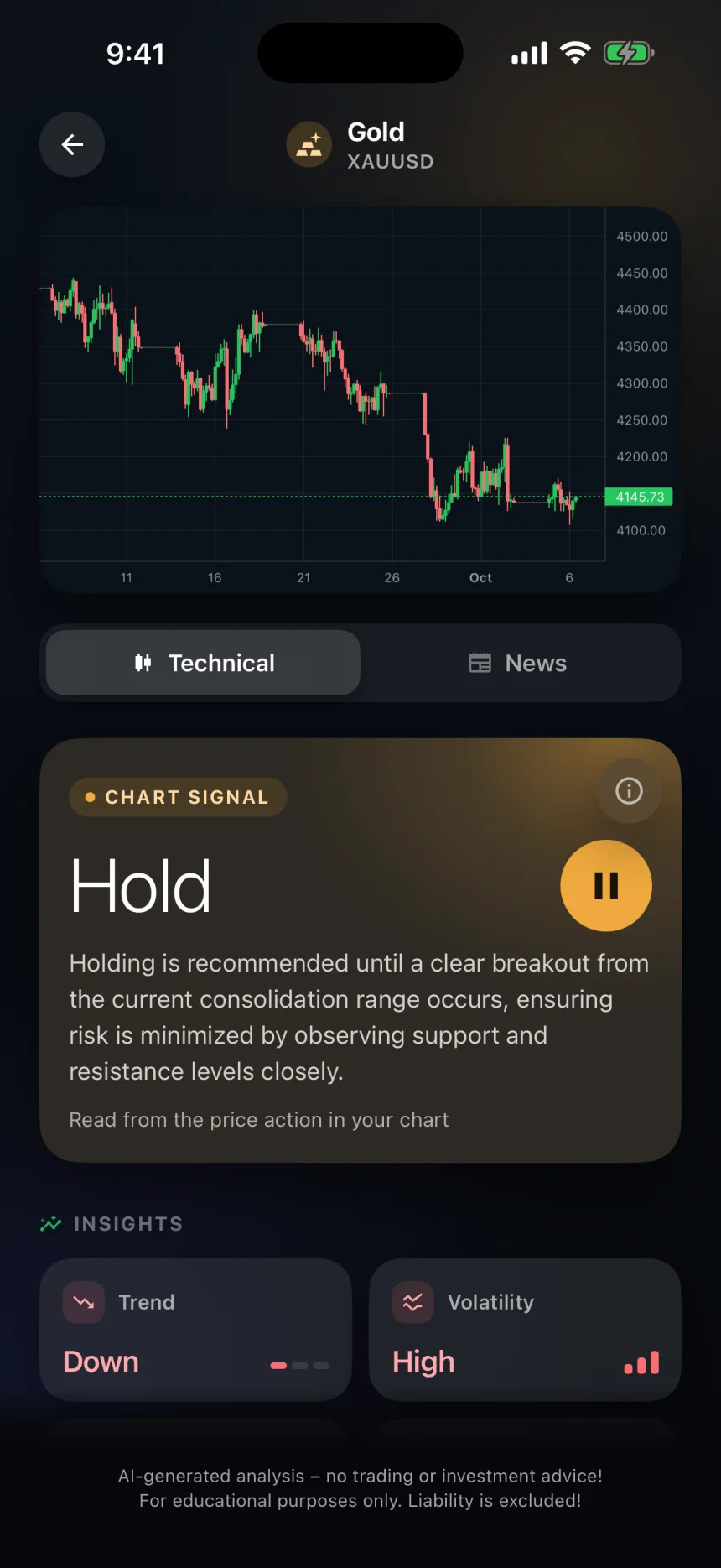
This is today's read on USD/CAD. Point your camera at any chart and ChartDetector AI gives you a full technical analysis in seconds — free on iPhone and Android.
AI-generated from public news sources. Not financial advice.