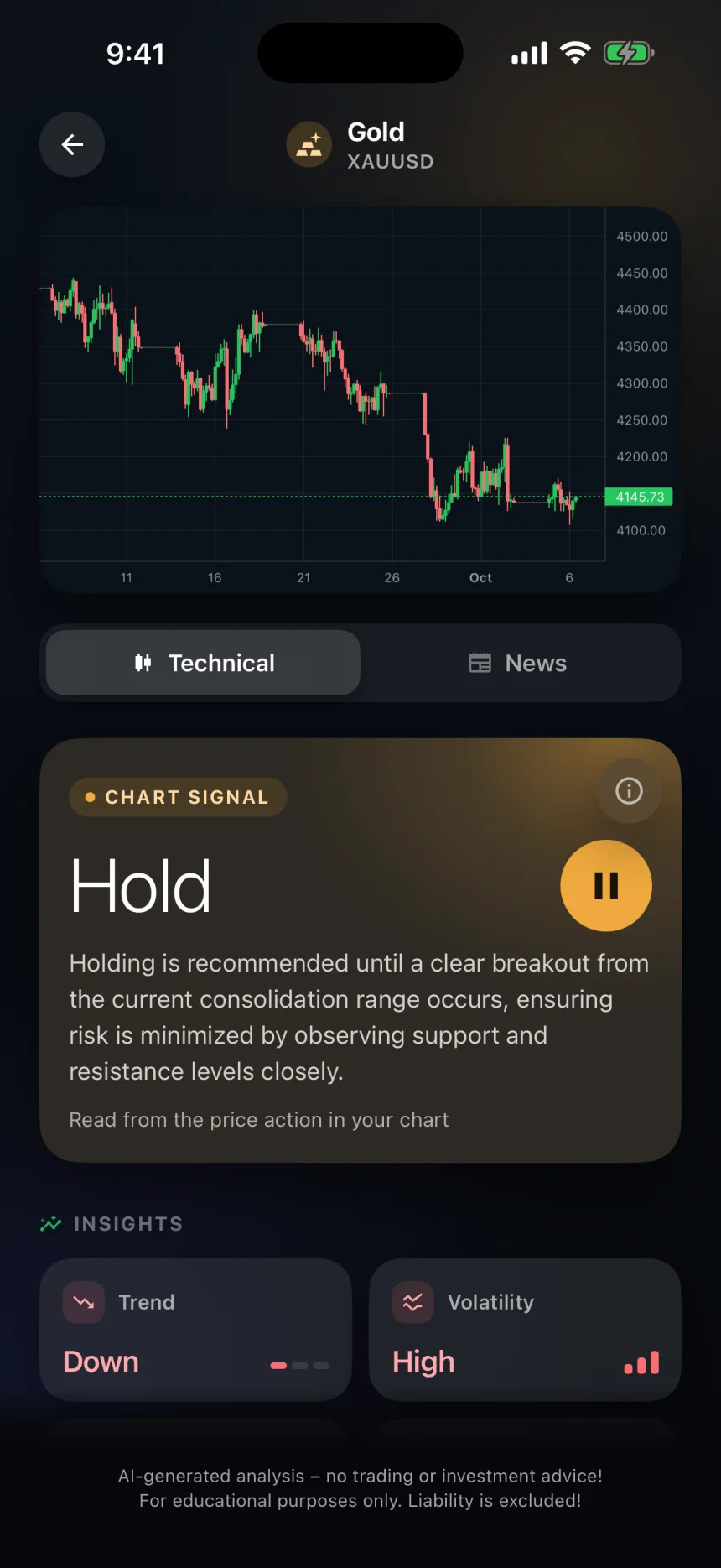
GoldXAUUSD
Daily Market Briefing
Latest briefing
Gold prices remain stable amid geopolitical tensions and market corrections.
Over the past 24 hours, gold prices have maintained stability despite geopolitical tensions and market corrections. An airstrike in the Sudan-Egypt border region resulted in at least 13 miners' deaths, highlighting ongoing regional instability. However, this event has not significantly impacted global gold prices. Analysts suggest that while the long-term bullish trend for gold remains intact, a healthy correction is expected before breaching the $4,000 per ounce milestone in 2026.
Previous briefings
Gold prices decline as rising oil prices revive Fed rate hike expectations
In the past 24 hours, gold prices have fallen below $4,200 per ounce, influenced by a stronger U.S. dollar and rising oil prices. These factors have intensified expectations of an additional Federal Reserve interest rate hike, pressuring gold prices downward.
Gold prices drop below $4,200 amid rising oil prices and Fed rate hike expectations.
Gold prices have fallen below $4,200 per ounce, influenced by escalating oil prices and renewed expectations of Federal Reserve rate hikes. This decline follows a significant drop of over 5% on October 12, marking the worst day for gold in 12 years. The combination of a stronger U.S. dollar and profit-taking has further pressured gold prices.
Gold (XAUUSD) rises to $4,191 amid weaker US dollar and falling Treasury yields.
Over the past 24 hours, gold prices have increased, reaching $4,191, supported by a weaker US dollar and declining Treasury yields. This upward movement follows a rebound from the $4,105 support level, with buyers now testing the $4,220 resistance. A breakout above this resistance could activate a Double Bottom reversal pattern, strengthening bullish momentum.
Gold prices decline below $3,950 amid global market uncertainty.
In the past 24 hours, gold prices have fallen below $3,950 per ounce, driven by a 1.5% drop as investors moved away from risk assets. This decline is attributed to a stronger U.S. dollar and expectations of tighter U.S. monetary policy, which have dampened gold's appeal.
Gold prices dip below $3,950 amid global market uncertainty
In the past 24 hours, gold prices have fallen 1.5%, dropping below $3,950 per ounce. This decline is attributed to a stronger US dollar and rising Treasury yields, which have dampened demand for the precious metal. Additionally, the ongoing US government shutdown has led to a lack of official economic data, increasing market uncertainty.
Gold prices drop below $4,200 amid rising dollar and Fed rate hike expectations.
Gold prices have fallen below $4,200 per ounce, influenced by a strengthening U.S. dollar and market expectations of further Federal Reserve rate hikes. The dollar index has climbed to a two-month high near 101.39, while the 30-year Treasury yield reached 5.52%, making gold less attractive to investors. Traders now anticipate a 66% probability of another Fed rate increase in October, with additional tightening expected through late 2027.
Gold prices decline to seven-week low amid rising rate-hike expectations
Over the past 24 hours, gold prices have fallen to a seven-week low, primarily due to increasing expectations of a Federal Reserve rate hike. This shift in market sentiment has reduced the appeal of non-yielding assets like gold. Despite softer inflation data, the strengthening U.S. dollar and elevated Treasury yields continue to weigh on gold prices.
Gold prices decline below $3,950 amid global market uncertainty.
In the past 24 hours, gold prices have fallen below $3,950 per ounce, driven by a combination of factors. A stronger U.S. dollar has made gold more expensive for foreign buyers, while a prolonged U.S. government shutdown has left investors without fresh economic data, increasing market uncertainty. Additionally, Federal Reserve Chair Jerome Powell's recent comments suggesting a pause in rate cuts have dampened expectations for further monetary easing.
Gold prices decline to seven-week low ahead of U.S. jobs report.
Gold prices have fallen to a seven-week low, influenced by a stronger U.S. dollar and elevated Treasury yields. The market is awaiting the U.S. non-farm payrolls report, which is expected to show a significant slowdown in job growth, potentially impacting Federal Reserve rate hike expectations.
Gold prices decline as rising energy costs and higher Treasury yields weigh on XAUUSD.
Over the past 24 hours, gold prices have experienced a decline, closing at $4,157.30 on September 30, 2026, down from $4,181.99 the previous day. This downturn is primarily attributed to escalating energy prices and increasing U.S. Treasury yields, which have overshadowed the support typically provided by softer U.S. inflation data. The combination of these factors has dampened gold's appeal as an inflation hedge.
Gold prices decline 3.4% amid global bond market sell-off, testing $4,160 support.
Over the past 24 hours, gold (XAUUSD) has experienced a significant decline of 3.4%, primarily driven by a global bond market sell-off that has pushed U.S. Treasury yields to new highs. The 2-year Treasury yield has surpassed 4.91%, the 10-year is nearing 5.24%, and the 30-year is testing 5.58%. This surge in yields has increased the opportunity cost of holding non-yielding assets like gold, leading to a sell-off in the precious metal. Currently, gold is attempting to hold the $4,160-$4,180 support range; a break below this level could expose it to further downside toward $4,000-$4,020.
Goldman Sachs raises December 2026 gold price forecast to $4,900/oz.
Goldman Sachs has increased its December 2026 gold price forecast to $4,900 per ounce, up from $4,300, citing strong Western exchange-traded fund (ETF) inflows and anticipated central bank buying. The bank expects central bank purchases to average 80 metric tons in 2025 and 70 tons in 2026, with emerging market central banks likely to continue diversifying their reserves into gold. Additionally, Western ETF holdings are projected to rise as the U.S. Federal Reserve is anticipated to lower the funds rate by 100 basis points by mid-2026.
Gold remains steady near $4,350 as easing geopolitical tensions and robust Chinese demand
Over the past 24 hours, gold prices have stabilized around $4,350 per ounce. This stability is attributed to declining crude oil prices and reduced U.S.-Iran tensions, which have alleviated some inflation worries and diminished the need for safe-haven assets. However, strong physical demand from China continues to provide underlying support for gold prices.
Gold prices decline to $4,274.18, down 2.4% for the week, amid rising Treasury yields.
Gold prices have fallen to $4,274.18 per ounce, marking a 2.4% decline for the week. This downturn is driven by increasing U.S. Treasury yields and expectations of further Federal Reserve rate hikes, which diminish gold's appeal as a non-yielding asset. Additionally, persistent inflation concerns and geopolitical tensions, particularly the U.S.-Iran conflict, have contributed to the bearish sentiment.
Gold prices dip as stronger dollar and rising yields weigh on XAU/USD.
In the past 24 hours, gold prices have declined due to a firmer U.S. dollar and increasing bond yields. These factors have reduced the appeal of non-yielding assets like gold, leading to a slight decrease in its price.
Gold (XAUUSD) Under Pressure as US Dollar Strengthens, Trading at $4,287.41
Over the past 24 hours, gold prices have been influenced by a stronger US dollar and rising Treasury yields, which have dampened demand for the non-yielding metal. Despite a decline in oil prices, gold has failed to find support, with spot gold trading at $4,287.41 as of September 23, 2026.
Gold prices decline as investors await Federal Reserve's next move.
In the past 24 hours, gold prices have experienced a slight decline as investors await the Federal Reserve's next move. The market remains cautious, with traders closely monitoring upcoming economic data and potential policy decisions.
Gold prices decline as rising Treasury yields and a stronger dollar weigh on the metal.
Over the past 24 hours, gold prices have fallen below the 200-day moving average, reaching a six-month low of $1,884. This decline is attributed to increased Treasury yields and a stronger U.S. dollar, which have diminished gold's appeal as a safe-haven asset.
Gold holds above $4,400 amid rising oil prices and Fed rate hike expectations.
Gold prices remained above $4,400 on September 8, 2026, as escalating Middle East tensions pushed oil prices higher, reigniting inflation concerns. This development, coupled with a strong U.S. employment report, increased market expectations of a Federal Reserve rate hike, placing downward pressure on gold. Investors are now awaiting upcoming U.S. inflation data to gauge the Fed's next move.
Gold surges to $4,504 as Fed signals rate hold and jobless claims rise.
Gold prices have surged to $4,504, driven by Federal Reserve Governor Christopher Waller's indication of supporting a rate hold if disinflation continues, and a rise in weekly jobless claims to 206,000, which softened yield pressures. The 10-year Treasury yield eased to approximately 4.77% from a peak near 4.81%, reducing the opportunity cost of holding gold. Silver also rose, confirming broad precious metals strength.
Gold prices decline as rising yields and a stronger dollar weigh on the metal.
In the past 24 hours, gold prices have fallen below the 200-day moving average, reaching a six-month low of $1,884. This decline is driven by increased rate-hike expectations, rising bond yields, and a strengthening U.S. dollar, which have diminished gold's appeal as a safe-haven asset.
Gold prices drop below $4,500/ounce after Fed Chair's hawkish remarks
Gold prices declined sharply, falling below $4,500 per ounce, following Federal Reserve Chair Kevin Warsh's hawkish comments at the Jackson Hole symposium. Warsh emphasized the Fed's commitment to controlling inflation, leading to expectations of further interest rate hikes and a stronger U.S. dollar, which negatively impacted gold.
Gold drops to $4,461 after BLS payrolls revision and hawkish Fed comments.
In the past 24 hours, gold prices declined to $4,461 following a downward revision of U.S. payrolls data and hawkish remarks from Federal Reserve Chair Kevin Warsh. The BLS revision indicated 79,000 fewer jobs added over the past year, reducing expectations for near-term rate cuts. Warsh's comments emphasized inflation as the primary risk, suggesting a potential rate hike in September.
Gold drops below $4,500 as Fed Chair Warsh signals potential rate hikes.
Gold prices fell below $4,500 following Federal Reserve Chair Kevin Warsh's hawkish remarks at the Jackson Hole Symposium, indicating potential interest rate hikes to combat persistent inflation. This stance strengthened the U.S. dollar and increased Treasury yields, diminishing gold's appeal. The market is now closely watching upcoming economic data and central bank communications for further direction.
Gold (XAU/USD) holds above $4,600 amid cautious trading ahead of Jackson Hole symposium.
Gold prices have stabilized above the $4,600 mark as traders await clearer signals on the Federal Reserve's interest rate path. The market is particularly focused on Federal Reserve Chairman Kevin Warsh's upcoming speech at the Jackson Hole symposium, seeking guidance on future monetary policy. Additionally, recent U.S. inflation data has provided some support to the U.S. Dollar, contributing to a cautious trading environment for gold.
Gold retreats from three-month high as traders await U.S. inflation data and Fed Chair's speech.
Gold prices reached a three-month peak near $4,700 but retreated as investors awaited U.S. inflation data and Federal Reserve Chair Kevin Warsh's speech. The market is cautious ahead of these events, leading to profit-taking and a slight pullback in gold prices.
Gold (XAU/USD) surges to $4,650 amid U.S. fiscal concerns and Treasury buybacks.
Over the past 24 hours, gold prices have climbed to $4,650 per ounce, reaching a three-month high. This rally is driven by U.S. fiscal concerns and the Treasury's decision to double long-term bond buybacks, which have weakened the U.S. dollar and increased demand for gold.
Gold surges to $4,661.60 amid U.S. Treasury buybacks and dollar weakness
Over the past 24 hours, gold prices have risen to $4,661.60 per ounce, marking a three-month high. This surge is driven by the U.S. Treasury's increased buyback of long-term bonds, which has led to lower yields and a weaker dollar, both of which support gold's appeal. Additionally, central bank demand, particularly from China, continues to bolster the precious metal.
Gold surges past $4,600 amid U.S. Treasury bond buybacks and dollar weakness.
In the past 24 hours, gold prices have risen above $4,600 per ounce, driven by the U.S. Treasury's decision to double its buybacks of long-term government bonds, which has weakened the U.S. dollar and increased demand for gold as a safe-haven asset. This move has also raised concerns about the sustainability of U.S. fiscal policy, further supporting gold's appeal.
Analyze any chart in seconds
This is today's read on Gold. Point your camera at any chart and ChartDetector AI gives you a full technical analysis in seconds — free on iPhone and Android.
AI-generated from public news sources. Not financial advice.