S&P 500SPX500
Daily Market Briefing
Latest briefing
S&P 500 rises 0.3% to 7,744.06, nearing record high amid healthcare sector gains.
On October 15, 2026, the S&P 500 increased by 0.3% to 7,744.06, approaching its record high. This uptick was driven by strong earnings reports from healthcare companies, which offset early losses linked to concerns over the sustainability of the AI boom. The index's performance reflects a market balancing optimism in certain sectors against broader economic uncertainties.
Previous briefings
S&P 500 drops 1.1% to 7,718.94 amid rising inflation and tech stock sell-off.
The S&P 500 declined by 1.1% to 7,718.94 on October 14, 2026, marking its fifth loss in six days. This downturn was driven by a 3.7% annual inflation rate in September, surpassing expectations and intensifying concerns over potential Federal Reserve interest rate hikes. Additionally, a sell-off in technology and AI-related stocks, including Nvidia, Broadcom, and AMD, contributed to the market's decline.
S&P 500 closes flat at 7,805.45 amid mixed earnings and chip stock declines.
On October 13, 2026, the S&P 500 ended virtually unchanged at 7,805.45, as strong corporate earnings were offset by declines in chip stocks. Major banks reported better-than-expected profits, but the technology sector faced pressure due to concerns over AI developments and rising Treasury yields.
S&P 500 dips 0.1% to 7,807.24 amid mixed trading and rising oil prices.
On October 12, 2026, the S&P 500 edged down by 0.1%, closing at 7,807.24, as investors balanced optimism from upcoming earnings reports against concerns over rising oil prices. Brent crude surged 1.8% to $106.65 per barrel, influenced by geopolitical tensions in the Middle East. Major banks, including Citigroup, JPMorgan Chase, and Wells Fargo, are set to release earnings this week, potentially impacting market sentiment.
S&P 500 declines 0.5% to 7,765 amid rising Treasury yields and tech sector concerns
Over the past 24 hours, the S&P 500 has experienced a 0.5% decline, closing at 7,765. This downturn is primarily driven by escalating long-term U.S. Treasury yields, which have heightened inflation concerns and investor apprehension. Additionally, the technology sector has faced challenges due to OpenAI's reported revenue shortfall, leading to significant losses among major AI-linked companies.
S&P 500 declines 0.5% to 7,765 amid rising Treasury yields and tech sector concerns.
Over the past 24 hours, the S&P 500 has experienced a 0.5% decline, closing at 7,765. This downturn is primarily driven by escalating long-term U.S. Treasury yields, which have heightened inflation concerns and dampened investor sentiment. Additionally, the technology sector has faced challenges due to OpenAI's reported annualized revenue of $50 billion—$20 billion below earlier forecasts—triggering investor anxiety about a potential slowdown in AI demand.
S&P 500 rises 0.6% to 7,811.54, nearing all-time high amid AI sector growth.
The S&P 500 advanced by 0.6% to 7,811.54, approaching its record high, driven by robust performance in the technology sector, particularly AI-related companies. This growth was tempered by concerns over rising Treasury yields and oil prices, which have introduced some market volatility.
S&P 500 declines 0.5% to 7,765.36 amid rising oil prices and tech stock losses.
The S&P 500 fell 0.5% to 7,765.36 on October 8, 2026, marking its second consecutive decline after reaching a record high. The drop was driven by a 4.1% surge in Brent crude oil prices to $104.28 per barrel, fueled by escalating Middle East tensions, and a 1.3% decline in the Nasdaq Composite, impacted by losses in technology stocks.
S&P 500 retreats 0.2% to 7,801.77 amid rising Treasury yields and oil prices.
The S&P 500 declined by 0.2% to 7,801.77 on October 7, 2026, as investors reacted to increasing U.S. Treasury yields and a rebound in oil prices. The 10-year Treasury yield climbed to 5.278%, its highest level since 2007, raising concerns about tighter monetary policy. Additionally, Brent crude oil prices surpassed $100 per barrel due to ongoing Middle East tensions, further pressuring the index.
S&P 500 hits record high of 7,818.93 on October 6, 2026, amid AI-driven rally.
The S&P 500 reached a new record high of 7,818.93 on October 6, 2026, driven by investor optimism surrounding artificial intelligence (AI) advancements and strong corporate earnings. The index surpassed its previous peak from August, reflecting sustained confidence in the market's growth potential. ([apnews.com](https://apnews.com/article/267ca73e15e09f7e8deb5f6076405f48?utm_source=openai))
S&P 500 rises 0.7% to 7,773.95, nearing all-time high amid tech gains.
The S&P 500 advanced by 0.7% to close at 7,773.95 on October 5, 2026, approaching its record high. This surge was driven by strong performances in major technology stocks and positive investor sentiment following significant buyout announcements. The Nasdaq composite also reached a new peak, rising 1.1% to 27,477.31.
S&P 500 rises 0.7% to 7,722.72 as weak jobs data eases rate hike concerns.
The S&P 500 gained 0.7% to close at 7,722.72 on October 2, 2026, following a weaker-than-expected September jobs report. The report showed only 29,000 new jobs added, significantly below the forecasted 93,000, leading to reduced expectations for a Federal Reserve rate hike this month. This development alleviated concerns over rising interest rates, contributing to the market's positive performance.
S&P 500 rises 0.7% to 7,722.72, nearing record highs after jobs report eases inflation fears.
The S&P 500 gained 0.7% to close at 7,722.72 on October 2, 2026, approaching its all-time high. This rally was driven by a jobs report indicating a slowdown in hiring, which alleviated concerns about rising inflation and reduced expectations of an imminent interest rate hike by the Federal Reserve.
S&P 500 rises 0.2% amid global bond market volatility and AI-driven tech gains.
On October 1, 2026, the S&P 500 edged up by 0.2%, ending a three-day losing streak. This modest gain was influenced by fluctuations in global bond yields and optimism in the technology sector, particularly surrounding artificial intelligence advancements.
S&P 500 declines 0.3% to 7,651.54 amid strong economic data and rising bond yields.
The S&P 500 fell 0.3% to 7,651.54 on September 30, 2026, as robust economic indicators, including a favorable inflation report, led to higher bond yields, which in turn pressured stock prices. The index has declined 1.2% over the past week but remains up 11.8% year-to-date.
S&P 500 declines 0.2% to 7,670.84 amid rising Treasury yields and geopolitical tensions.
The S&P 500 fell 0.2% to 7,670.84 on September 29, 2026, influenced by increasing long-term Treasury yields and ongoing geopolitical tensions. The 10-year Treasury yield reached 5.25%, the highest in 24 years, raising concerns about economic growth and stock valuations. Additionally, the U.S.–Iran conflict has led to volatile oil prices, further impacting market sentiment.
S&P 500 drops 0.8% to 7,683.69 amid rising bond yields and geopolitical tensions.
The S&P 500 declined by 0.8% to 7,683.69 on September 28, 2026, driven by a surge in bond yields and escalating geopolitical uncertainties. The 10-year Treasury yield reached 5.23%, its highest since 2007, influenced by inflation concerns and a resilient economy. Additionally, tensions over the Strait of Hormuz, particularly involving Iran, contributed to market volatility.
S&P 500 remains near record highs amid easing oil prices and bond yields.
Over the past 24 hours, the S&P 500 has maintained its position close to record highs, supported by a decline in oil prices and bond yields. These factors have alleviated some inflationary pressures, contributing to market stability.
S&P 500 closes at 7,764.70, nearing record high amid easing oil prices and bond yields.
The S&P 500 surged 1.5% to 7,764.70, approaching its record high, driven by declining oil prices and bond yields. Brent crude oil fell 3.4% to $100.34 per barrel, and the 10-year Treasury yield eased to 4.95%, alleviating market pressures.
S&P 500 remains near record highs amid fluctuating oil prices and global uncertainties
Over the past 24 hours, the S&P 500 has maintained its position close to record highs, despite market fluctuations and global uncertainties. The index is currently hovering just 0.4% below its all-time peak, with Brent crude oil prices briefly dipping below $98 per barrel before recovering to $100.19. This stability reflects investor confidence amid ongoing geopolitical tensions and economic data releases.
S&P 500 closes at 7,650.50, up 0.2%, amid rising bond yields and fluctuating oil prices.
In the past 24 hours, the S&P 500 experienced a modest gain of 0.2%, closing at 7,650.50. This uptick occurred despite rising bond yields and fluctuating oil prices, indicating a market balancing act between these opposing forces.
S&P 500 remains near record highs amid oil price fluctuations and strong corporate earnings.
The S&P 500 continues to hover just 0.4% below its all-time peak, supported by robust corporate earnings and a slight dip in oil prices. Brent crude oil briefly fell below $98 per barrel but later recovered to $100.19, influenced by ongoing Middle East tensions. Strong earnings reports from companies like AutoZone and Thor Industries have bolstered market confidence.
S&P 500 surges 1.5% to 7,764.70, nearing record high amid easing oil prices
The S&P 500 experienced a significant rally, climbing 1.5% to 7,764.70, bringing it within 0.4% of its record high. This surge was driven by a decline in oil prices and bond yields, which alleviated inflationary pressures and reduced borrowing costs. Additionally, positive diplomatic developments between the U.S. and China contributed to the market's optimism.
S&P 500 rises 1.1% to 7,637 as Fed rate hike uncertainty eases
The S&P 500 gained 1.1% to close at 7,637 on Thursday, September 17, 2026, following the Federal Reserve's quarter-point interest rate hike—the first since 2023. Investor sentiment improved as concerns over future rate hikes diminished, leading to a broad market rally.
S&P 500 closes at 7,650.50, up 0.2%, amid rising bond yields and fluctuating oil prices.
In the past 24 hours, the S&P 500 experienced a modest gain of 0.2%, closing at 7,650.50. This uptick occurred despite rising bond yields, with the 10-year Treasury yield climbing to 5%, and fluctuating oil prices, which briefly dipped below $102 before recovering. These mixed signals suggest a cautious market sentiment.
S&P 500 edges up 0.2% to 7,650.50 amid rising bond yields and oil prices.
The S&P 500 closed at 7,650.50 on September 18, 2026, marking a 0.2% increase. This modest gain occurred despite rising bond yields and fluctuating oil prices, indicating investor caution amid economic uncertainties. ([apnews.com](https://apnews.com/article/da0dbe004b6f83c36e7d1626a9741a92?utm_source=openai))
S&P 500 rebounds 1.1% to 7,637.76 as oil prices and bond yields decline.
The S&P 500 experienced a 1.1% increase to 7,637.76 on September 17, 2026, driven by a 1% drop in Brent crude oil prices and a decrease in the 10-year Treasury yield from 5.01% to 4.93%. These movements eased inflation concerns and reduced borrowing costs, contributing to the market's positive momentum.
S&P 500 drops 0.4% to 7,551.81 after Fed's first rate hike in three years.
The S&P 500 declined by 0.4% to 7,551.81 on September 16, 2026, following the Federal Reserve's first interest rate increase in three years aimed at combating persistent inflation. Fed Chairman Kevin Warsh indicated that inflation remains too high and suggested the possibility of further rate hikes. This announcement led to market concerns about higher borrowing costs and their potential impact on economic growth.
S&P 500 declines 0.4% to 7,585.73 amid rising oil prices and Treasury yields.
On September 15, 2026, the S&P 500 fell by 0.4% to 7,585.73, influenced by escalating oil prices and increasing Treasury yields. Brent crude oil surged 2.9% to $108.75 per barrel, while the 10-year U.S. Treasury yield reached 5.00%, its highest since 2023. These factors heightened inflation concerns and fueled expectations of a potential Federal Reserve interest rate hike.
S&P 500 declines 0.5% amid AI stock sell-off and rising oil prices
The S&P 500 fell 0.5% on September 14, 2026, driven by a global sell-off in AI-related stocks following industry leaders' calls for a slowdown in AI development. Additionally, escalating oil prices, influenced by Middle East tensions and disruptions to Saudi oil infrastructure, briefly pushed the 10-year U.S. Treasury yield to 5%, raising concerns about inflation and potential Federal Reserve rate hikes.
Analyze any chart in seconds
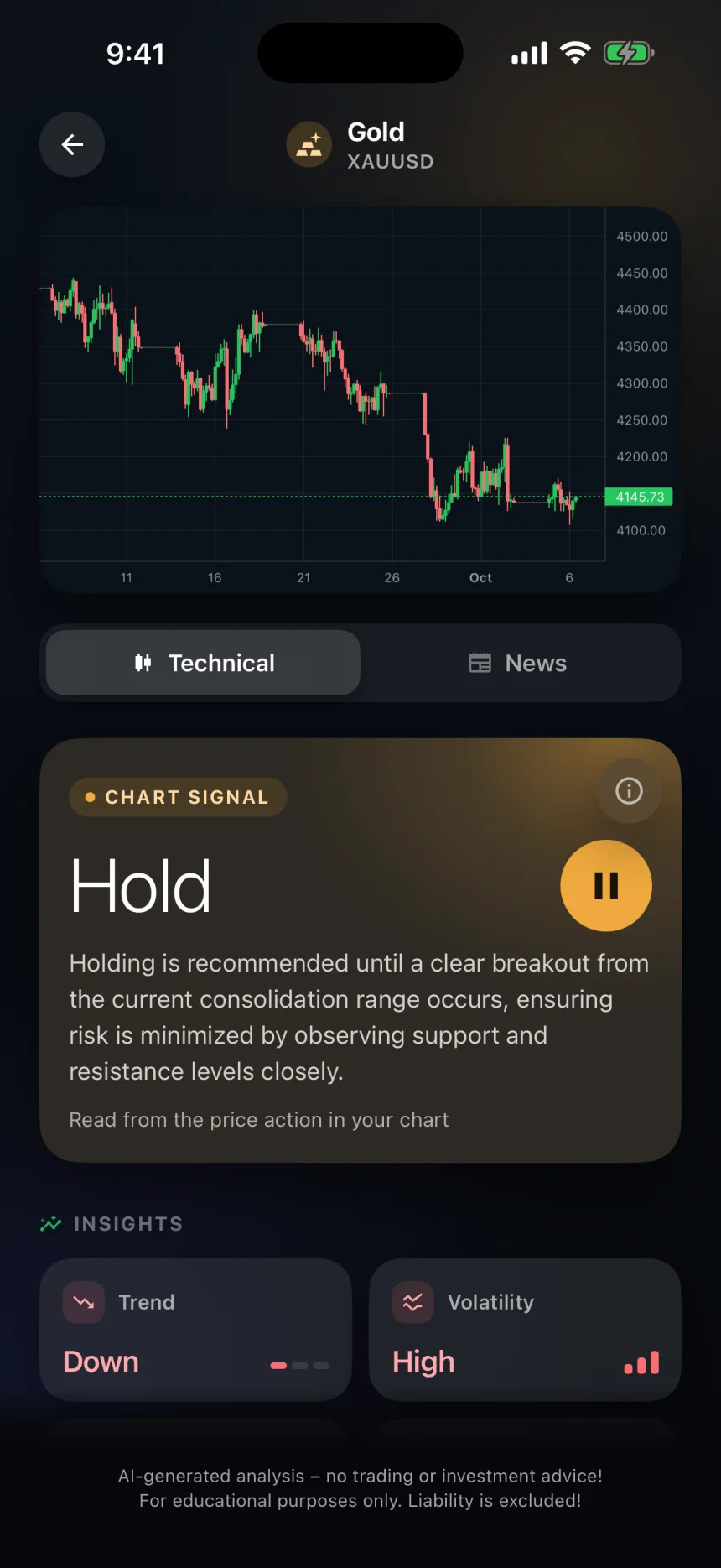
This is today's read on S&P 500. Point your camera at any chart and ChartDetector AI gives you a full technical analysis in seconds — free on iPhone and Android.
AI-generated from public news sources. Not financial advice.