CAC 40CAC40
Daily Market Briefing
Latest briefing
CAC 40 rises 0.8% to 7,935 points as consumer stocks lead gains
The CAC 40 index closed at 7,935 points on October 15, 2026, up 0.8%, driven by strong performances in consumer stocks. Pernod Ricard's smaller-than-expected sales decline and Publicis Groupe's positive earnings report bolstered investor confidence. However, technology shares, notably STMicroelectronics, faced declines amid a global tech selloff.
Previous briefings
CAC 40 rises 0.58% to 7,873.11 points amid easing energy concerns
The CAC 40 index closed higher on October 14, 2026, driven by gains in the consumer services, healthcare, and consumer goods sectors. The market sentiment improved as energy supply concerns eased, with Brent crude oil prices stabilizing. Additionally, positive earnings reports from companies like ASML and STMicroelectronics bolstered investor confidence.
CAC 40 closes 0.11% lower at 7,825 points amid mixed sector performances.
The CAC 40 index edged down by 0.11% to close at 7,825 points on October 13, 2026. The decline was led by STMicroelectronics (-4.04%), Credit Agricole (-2.54%), and Hermès International (-2.29%). On the upside, the strongest performers were Pernod Ricard (+4.48%), Capgemini (+3.42%), and Edenred (+3.18%).
CAC 40 rises 0.38% to 7,833 points as oil concerns ease
The CAC 40 index closed at 7,833 points on October 12, up 0.38%, as easing energy supply concerns alleviated market pressures. Brent crude oil prices fell to $102.33 per barrel, contributing to the positive sentiment. However, investor confidence remains cautious due to ongoing fiscal challenges in France.
CAC 40 declines 1.94% to 3-month low amid sector-wide sell-off
Over the past 24 hours, the CAC 40 index has experienced a significant decline, reaching a three-month low. This downturn is primarily driven by broad-based sell-offs across major sectors, including industrials, consumer goods, and healthcare. Investors are also expressing concerns over France's fiscal stability, with the euro hitting a 17-month low against the US dollar and French bond yields approaching 5%, the highest since 2002.
CAC 40 declines 0.80% amid investor concerns over France's fiscal stability
Over the past 24 hours, the CAC 40 index has experienced a decline of 0.80%, closing at 7,803.33 points. This downturn is primarily driven by investor apprehension regarding France's fiscal health, particularly its escalating public debt and the government's challenges in passing the 2027 budget. These concerns have led to increased bond yields and a weakening euro, further impacting market sentiment.
CAC 40 rises 0.8% to 7,789 points, led by ArcelorMittal and Capgemini gains.
The CAC 40 index increased by 0.8% to 7,789 points, driven by strong performances from ArcelorMittal and Capgemini. This uptick was supported by declining oil prices and bond yields, which bolstered investor sentiment.
CAC 40 declines 0.80% amid rising oil prices and bond yields
On October 8, 2026, the CAC 40 index fell by 0.80%, closing at 7,708.45 points. This decline was driven by escalating oil prices and increasing bond yields, which heightened inflation and interest rate concerns among investors. Notably, the yield on France's 10-year government bonds rose to 4.975%, and Brent crude prices surged to $105.20 per barrel.
CAC 40 declines 1.22% to 7,769.21 amid sector-wide losses
The CAC 40 index fell 1.22% to 7,769.21 on October 7, 2026, driven by widespread sector losses. Schneider Electric's 10% drop significantly impacted the index, following its announcement of acquiring PTC for $22.6 billion. The euro also weakened, reaching its lowest point since May 2025, amid ongoing budgetary and political concerns.
CAC 40 rebounds 0.40% to 7,865.07; Schneider Electric drops 4.51% after PTC acquisition
The CAC 40 index closed at 7,865.07 points on October 6, 2026, up 0.40% from the previous session. The rebound was supported by easing oil prices and bond yields, though concerns over France's fiscal outlook and political uncertainty continue to influence market sentiment. Schneider Electric's announcement of a €22.6 billion acquisition of PTC led to a 4.51% decline in its shares, as investors assessed the debt-funded deal.
CAC 40 declines 0.80% to 7,834.10 points amid budgetary concerns
The CAC 40 index fell by 0.80% to 7,834.10 points on October 5, 2026, driven by losses in the industrials, consumer services, and software sectors. Budgetary uncertainties continue to weigh on investor sentiment, contributing to the index's decline.
CAC 40 rises 0.69% to 7,889.67 amid falling oil prices and strong tech sector performance.
The CAC 40 index gained 0.69% to close at 7,889.67, driven by a decline in oil prices and robust performance in the technology sector. Stellantis and STMicroelectronics led the gains, while Kering and Sanofi were notable decliners.
CAC 40 rises 1.2% to 7,200 amid strong earnings reports
The CAC 40 index surged 1.2% to close at 7,200 on October 1, 2026, driven by robust earnings reports from major French companies. Investors responded positively to strong financial performances, boosting market sentiment.
CAC 40 declines 0.89% to 7,965 points amid sectoral losses
The CAC 40 index fell by 0.89% to close at 7,965 points on September 30, 2026, driven by declines in the energy, financial, and industrial sectors. This marks the index's seventh consecutive week of contraction, breaching the 8,000-point threshold.
CAC 40 declines 0.53% to 8,035.87 amid sector-wide losses
On September 29, 2026, the CAC 40 index fell by 0.53% to close at 8,035.87 points, marking a three-month low. The decline was driven by losses across the energy, consumer goods, and healthcare sectors, which offset gains in technology and luxury goods.
CAC 40 closes nearly flat as gains in luxury and healthcare offset losses in financials.
On September 28, 2026, the CAC 40 index ended the trading session virtually unchanged, rising just 0.01%. This stability masked significant sectoral divergences, with gains in luxury and healthcare stocks counterbalancing declines in financials and utilities. Investor sentiment remained cautious, as evidenced by the CAC 40 VIX holding at a new 52-week high of 18.96.
CAC 40 declines 0.52% amid sector-wide losses; Stellantis hits 5-year low
The CAC 40 index fell 0.52% on September 24, 2026, driven by declines across technology, healthcare, and industrial sectors. Automaker Stellantis saw its shares drop to a five-year low, contributing significantly to the downturn.
CAC 40 closes nearly flat as energy and luxury stocks offset banking gains.
On September 25, 2026, the CAC 40 index ended the trading session virtually unchanged, dipping by just 0.04%. This stability was the result of declines in major energy and luxury goods companies, which counterbalanced gains in the banking sector. The broader SBF 120 index also edged lower, reflecting a mixed market sentiment.
CAC 40 declines 0.52% to 8,081.43 amid sector-wide losses
The CAC 40 index fell 0.52% to 8,081.43 points on September 24, 2026, driven by widespread declines across sectors, including technology, healthcare, and industrials. Investors exhibited caution, leading to a negative market breadth with more decliners than advancers.
CAC 40 declines 0.12% to 8,144.80 amid cautious investor sentiment.
Over the past 24 hours, the CAC 40 index experienced a slight decline of 0.12%, closing at 8,144.80 points. This movement reflects a cautious approach among investors, with the index fluctuating between a high of 8,199.66 and a low of 8,116.52 during the session. The market's subdued performance is attributed to a combination of global economic uncertainties and sector-specific challenges.
CAC 40 rises 0.92% as tech and industrial stocks lead gains
The CAC 40 index closed 0.92% higher on Monday, driven by strong performances in the technology and industrial sectors. Despite the positive close, underlying market indicators suggest cautious investor sentiment.
CAC 40 drops 1.49% to 8,065.02, hitting a three-month low amid broad sector losses.
The CAC 40 index declined by 1.49% to 8,065.02 on September 18, 2026, reaching its lowest point in three months. This downturn was driven by significant losses across the consumer goods, financials, and basic materials sectors, reflecting widespread investor concerns.
CAC 40 rises 0.57% to 8,197.47 amid global market optimism.
The CAC 40 index increased by 0.57% to close at 8,197.47 on September 17, 2026, driven by gains in the financial, industrial, and utilities sectors. This uptick aligns with a broader global rally following the Federal Reserve's anticipated 25 basis point rate hike and its commitment to controlling inflation. Positive market sentiment was further bolstered by lower bond yields and softer oil prices.
CAC 40 rises 0.62% to 8,140.59 amid industrial gains and auto sector decline.
The CAC 40 index closed higher by 0.62% at 8,140.59 points, driven by gains in industrial and utility stocks. However, this positive momentum was offset by a significant sell-off in the automotive sector, with Stellantis shares reaching a five-year low.
CAC 40 closes 0.34% lower at 8,090.28 amid weak trading session
The CAC 40 index declined by 0.34% to close at 8,090.28 points on September 15, 2026, following a weak trading session. The day's trading saw a high of 8,110.58 and a low of 8,033.04 points. The index's market capitalization stood at €2.452 trillion.
CAC 40 declines 0.76% to 8,117.78 amid oil surge and tech sell-off.
The CAC 40 index fell 0.76% to 8,117.78 points on September 14, 2026, driven by a sharp rise in oil prices and a sell-off in the technology sector. Brent crude futures climbed to $108.65 per barrel, raising concerns over supply disruptions following Saudi Arabia's suspension of a key pipeline after recent drone attacks. Additionally, warnings of potential large-scale AI-driven cyberattacks led to significant declines in tech stocks.
CAC 40 rises 0.78% to 8,179.77 amid gains in energy and industrial sectors.
The CAC 40 index increased by 0.78% to close at 8,179.77 points, driven by strong performances in the energy and industrial sectors. This uptick reflects investor optimism despite ongoing inflation concerns.
CAC 40 edges higher as ECB rate decision looms, closing at 8,178.32 points.
The CAC 40 index inched up by 0.17% to close at 8,178.32 points on September 10, 2026, as investors awaited the European Central Bank's monetary policy announcement. Oil prices continued to rise amid ongoing Middle East tensions, with Brent crude futures climbing to $102.72 a barrel before easing to around $102.10. The ECB is widely expected to raise key interest rates later today after pausing in July, with President Christine Lagarde's comments and updated economic forecasts in focus.
CAC 40 declines 1.59% to 8,185.41 amid rising oil prices and weak industrial data.
The CAC 40 index fell 1.59% to 8,185.41, driven by escalating oil prices and disappointing industrial production figures. Brent crude surged to $100.49 per barrel, while WTI reached $95.09, influenced by Middle East tensions. Additionally, unexpected declines in French industrial output heightened concerns about economic growth.
CAC 40 declines 0.09% amid geopolitical tensions and weak services PMI data
The CAC 40 index experienced a slight decline of 0.09% on September 4, 2026, closing at 8,272.77 points. This downturn was influenced by ongoing geopolitical tensions in the Middle East and a contraction in business activity, as indicated by the latest services PMI data. Notably, the luxury sector faced significant losses, with companies like LVMH, Hermès, and Kering dropping 2.4% to 3.1%.
Analyze any chart in seconds
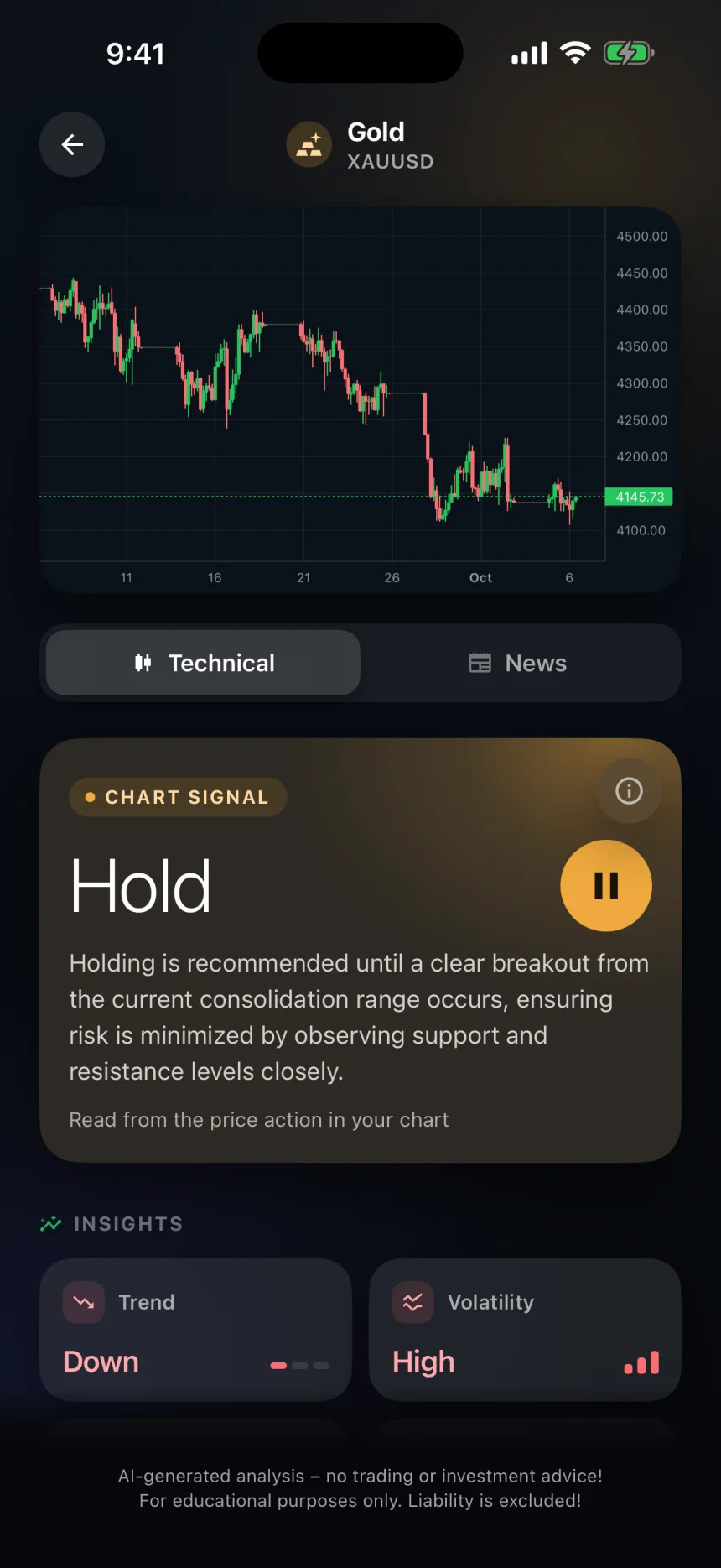
This is today's read on CAC 40. Point your camera at any chart and ChartDetector AI gives you a full technical analysis in seconds — free on iPhone and Android.
AI-generated from public news sources. Not financial advice.